It would be better to simply admit my various self-inflicted difficulties and then, with a wave of the hand and even maybe a bobbing of the neck, run straight into whoever I happen to be addressing right now. I bet you thought I'd never post again. We'll, you were probably write. This, after all, is hardly a post, just of few thoughts, with a not-so-clever title, jotted down, run-on sentences especially, and, of course, but also rather uncharateristically, no spell check (too lazy). I'd probably be a better writer in German. As it stands now, it would be better simply to admit my various self-inflictions, and do so, without the ordinary hesitation, as a way out of the quiet all-pervasiveness of an ordinary, ordinary future career. It is fast impossible to write, what could one write anyway; what, and still BE right? They were, we all, I suppose, would agree, but not any more; about what now could they be right? Or wrong? About town? Or the world about Harmon Industrial Park? A shanty, that last one, and full of truck-keys, but don't call them so to their face. Anyway, hard drugs, I've always said, would be the perfect excuse, but I forgot to take them, and so cannot make sense of the present, another sad mistake of the past, which, if you follow me, might suppose a messiah, who would come, in the future I suppose, and redeem even my choice, sad choice, not to take hard drugs, in the past. OR just take 'em later.
Anyway, I, like you, am endowed with the capacity to understand deeply this specific world of mine. Today, I prefer to pretend, but it is all on the way to an in-fact deeper understanding. One must simply overcome those all too common deceits, the one by which we fool ourselves, and become either happy or sad. But a new difficulty has arisen: language. You see when I say to-do I mean Grand ol' USA, and when I say about I mean bad-habits, futher a serpent represents a unicorn in all cases no better than say a commodity-exchange or harp would, and again vice versa. So that if he had so much to-do, and what he did was a unicorn, I'd be saying just about nothing. It's a bad example, but I'm really not putting too much thought into any of this. Notice, however, that there are still spaces between the words, making them all half un-words, and each one individually is really not worth much more than the next, so we have quite a system, but also a broken one, having but with few exceptions no room for art in science, etc, etc, etc.
I'll leave you with some really great poetry:
Give that whore a buck, and she'll suck you Chuck,
It's not worth more, 'cause that dirty 'ol whore
she's got fuckin' herpes.
See her standing there, just like a model airplane in a hobby shop with no more customers, ever.
And that's because I have a toothache, no matter what, it's mine.
Wednesday, April 18, 2007


Wednesday, February 21, 2007
A Post! A Post!

September 11 inaugurated both the age of terrorism in US foreign policy and the demand that we identify ourselves ideologically as anti-terrorist. This double action defines and demarcates the political space in which we now live; it begins the movement of our democracy into its other, into that in opposition to which we have until now defined ourselves, namely totalitarianism. History has long prepared this road, but history can no longer be appealed to as either the genitor or as the possibility of escape or redemption. The force of the contradiction born on September 11 is that of a rupture with history: we now live, both as a culture and as individuals, somewhere between absolute forgetting and déjà vu. History will only resume after the fact, when the rupture is complete and the new system has already erected its edifice. At that time we will wander around as shock victims, with dust in our hair and on our clothes, and remembering finally what has taken place, we will have no recourse but to vomit.
Wednesday, January 03, 2007
A Fisherman's Story
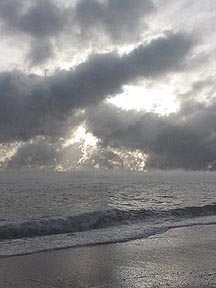
A certain type of fog can be experienced on all those tropical islands which hover near the equator. It is a fog that comes only seldom; and this infrequency is the cause for much speculation among indigenous peoples. It is not, as one might romantically suppose, a midnight-in-a-graveyard type of fog; that is to say that it is not a thing to frighten children, and in fact most children are less afraid of this strange fog than adults. Children, it has also been maintained by certain western anthropologists who study the fog, are more likely even to see the fog. Roughly, this has something to do with their still intimate and relatively naïve relationship to nature; they are more likely to see the fog because they are more likely to be outside, or at least to be looking out the schoolhouse window. This is, moreover, not hard to believe, owing to the nature of the education they mostly receive, and of course to the certain cultural differences existing between the missionary-teacher and the authentic-islandman-student.
The fog, as one might well suppose, becomes thicker when one is out to sea. But there are many types of sea fog, some of which, far from being innocuous, can portent certain doom to small boats and are therefore avoided by fishermen. This, however, is not the case with the fog that we are here concerned with. Many primitive island-societies existing near the equator have (mostly oral) folktales which describe poetically the great schools of fish that can be found ‘neath our particular fog. Only the oldest and most expert fishermen can ever hope to tell the difference between our fog and the harmful fogs that one may encounter at sea. Accordingly, many a novice has died hoping rather to be rich and to feed his family well. Indeed it is customary on some islands to lament the cause of death of some young fisherman as having been “swallowed by the fog”, or “lost in foggy temptation.”
While on the islands I met an old fisherman and I inquired of him whether or not he had ever been so lucky as to fish ‘neath such a miraculous fog. He was missing many teeth, but his smile was genuine. He detailed to me his extraordinary autobiography which I will paraphrase here. This man, whose name is simply unpronounceable in English, so we’ll just call him Carl, had been raised even as a young boy to be a fisherman. His father was something of a local hero, famous both for his brave deeds in war and his huge catches. When Carl was just barely able to walk, although apparently already able to swim like a fish (which, it is worth mentioning, is something rather uncommon among island people), his father would take him out on his little outrigger and fish with him from sunrise to after dark. On these fishing excursions, Carl recalls, his father was always able to find that tiny floating patch of fog ‘neath which the fish so gladly swim. These were the happiest times of Carl’s life; everyday they would bring home such a bounty of fish that they could easily feed the whole neighborhood or small village.
On day Carl’s father died and he was expected to take over his fishing duties. He recalls that he was excited; confident in his knowledge of how to find and distinguish the special fog. But Carl never was able to fish ‘neath the fog, for every time he entered a fog it always turned out to be one of the harmful types. Carl recounted to me many dangerous adventures that he had had trying to escape from these sea fogs. Some, he said, could simply pull the whole boat under, and he had to rely on his great strength (and occasionally on his exceptional swimming ability) to dodge certain death. With tears in his eyes he spoke of the poverty into which his unsuccessful fishing trips plunged his whole village. Children would die of hunger, and the adults were too weary to do their work. Eventually the village had no recourse but to expel Carl and the evil spirits that he carried with him. They came to his home in the night and carried him to a boat which had been ritualistically prepared with blood and the ashes of burnt corpses; they filled his fishing net with stones and threw it into the sea. The villagers told Carl to leave and never return. Carl was heartbroken, for he loved his village and had recently become engaged to a woman who, by his own description, could rival even Helen of Troy.
He set off onto the great ocean and it was not long before he spied a familiar fog. Here it was, once again, that deadly fog that he could only ever seem to find. Tired of life and unhappy he sailed directly into its mists. The ocean heaved and pulled him and his boat under. He was dead, he says, for many hours or days, and then he awoke here on this island. He has never since sailed, but he yearns everyday for the people he has lost. He does not understand why God brought him to this island, where he is nothing better than a beggar. This last bit, however, did not seem true to me. I had, after all, met his lovely wife and children, and, judging by the size of his house and the great number of guests he seemed always to be entertaining, he appeared to be a respected member of the community. On the whole I can do nothing but attribute his last outburst to the powerful emotions which must have overtaken him at the retelling of his sad story. I asked him if he had not tried to contact his lost village, and he told me that he had not. I promised him that, if I happened upon the place during my research, I’d tell the people there that he was alright, and he seemed greatly pleased at this. But I have never, despite repeated inquiries, found his little island. This is especially disheartening for me because, by Carl’s account, there must be much fog there to study.
Friday, December 08, 2006
Post #14
Let us be realistic. Let us invent for ourselves, from our most sincere observations, a system of values which is, above all, applicable. Let us, first, be satisfied to torment ourselves with the non-fulfillment of groundless and empty desires. Let this superficial torment our souls. But simulteanously, let us avoid the temptations of materialism. Rather, let us be as Robin Hood, let us live as beggars do, and yet demand, to the boundless appetites of our stuffed bellies, boundless satisfaction. That is to say, let us require ever more and more, and let us yearn for only expensive delicacies, then let us lament our unsatisfaction as the poets do; it is not enought to be wanting, we must also be throwing away. We may then, if we are successful, prostrate ourselves before the crying god, wail and bemoan our unhappyness, and find solace in each other's arms. We may then have the excuse to touch each other. Let us envy every poor man, every religious man, for his depth, the depth we sacrifice to live more truly (more or less according to our nature), in order to be better in both fiction and reality, namely in suffering, than those unfortunate men who suffer only narrowly, from hunger and at the hands of greedy men.
This is the foremost value of our new age. Any modern system of values must have suffering at its center. The world itself is more alive where there is more suffering; more dead where the people are satisfied and thereby made dull. All man made worlds are built on suffering, just like the Great Wall is home also to the bones of many poor labourers. Suffering losens the toung, lending fire to tears and words, and art to the general. Satisfaction, on the other hand, losens the sexual organs, and lends itself primarily to impersonal, passionate, contraceptive sex.
This is the foremost value of our new age. Any modern system of values must have suffering at its center. The world itself is more alive where there is more suffering; more dead where the people are satisfied and thereby made dull. All man made worlds are built on suffering, just like the Great Wall is home also to the bones of many poor labourers. Suffering losens the toung, lending fire to tears and words, and art to the general. Satisfaction, on the other hand, losens the sexual organs, and lends itself primarily to impersonal, passionate, contraceptive sex.
Monday, October 30, 2006
Final Quiz Review Sheet

Before Carl's face loomed the hallway, so dark that he could not make out one detail past just a few inches. Only rarely had anything loomed before Carl, he not being a face-to-face person anyway. Carl preferred to make himself slight and scamper around, holding always before his eyes only those actions, of the greatest industry and articulation, which entailed constant production. He resembled a thick-shelled beetle, but softer and plumper. He would not bow nor scrape--he was no yes man, believing instead strictly in the truth--and he prided before all else his ability to finish the job. Behind open-faced hands it was whispered that he never slept, and would rummage through the commodious storehouses long after all the lights had been shut off and all the people gone home to their wives and beds. It happened occasionally that his co-workers would find him drowsing, shaking back and forth, on some dirty sofa in the rec-room. They would lift him up, carry him on their backs to some cot secreted in the janitor's closet, and deposit him there. Once or twice he had slept their all day. The room was, despite being so far underground, dingy, hot, and humid. Condensation as thick as blood was constantly gravitating toward the ever growing wetlands of sweet-smelling mold on the carpet. On their way, these snail-trails would salvage for themselves whatever bits of crap happened to be trying to block their path. In the top left corner of the room, facing the door, an air-duct led to airier places.
It was on one of his late nights that Carl chanced to notice the looming hallway. He must have passed by it thousands of times, never once considering it. Maybe it was because he had finished finally his various odd-jobs, that on this particular night he found himself feeling nervous, and lingered there so long. He shone his flashlight all around, but he was unable to chase away the conglomerate, jumping shadows. Because it was useless, he turned off his light, and swallowing deeply he headed straight into the darkness. Not ten steps later he bumped into somebody. He was afraid; he knew that nobody but himself stayed around so late. Pensively he called out a hello. "Hello" echoed some invisible voice. "Who are you?" asked Carl, "everybody I know went to bed long ago." "Oh, I don't ever sleep" said the voice. All of a sudden a match was lit, accompanied by the characteristic sounds and smells, the light fell to a candle, which, once lit, illuminated the face of an old man. He wore a long white beard, stained with crumbs and goo. He was leaning on a grey metal desk, and he wore a old, decaying vest and a blue silk tie. "I've worked here since long before you were born, I'm sure. I have many responsibilities. They send my meals down to me; I never leave my station I'm that busy. That's probably why you've never seen me before now." "What is your title?" asked Carl. "I'm head of information acquisition and filing," the old man replied, "but I'm sorry to cut this short, I'm afraid I must ask for you authorization. I'm not even allowed to speak with you unless you bear a signature from the chief." "Excuse me," said Carl, "I came here entirely accidentally." "Well then, you are definitely not going to get in to see the collections in that case. I am supremely important, you know, it would probably help if you bowed to me." The way the old man said this made Carl feel uncomfortable. "I guess I'll leave then." "No. Wait, it's been so long, I really want to show somebody my work. I'm not such a square that I cannot disobey a rule or two every once in a while. Besides, I'm very proud of my work," said the old man with a grin, "come on then." "Thank you," replied Carl, "I was really hoping to see it, I guess."
The old man led carl around the desk, they had to squeeze because it was pushed up so close to the wall. The old man took a key out of his pocket and unlocked a rusty iron door. As the door swung open Carl was blinded by a light which seemed to stream without any definite source from the terrible storeroom beyond. The ceiling was easily fifty or sixty feet high--"it must be pushed up right against the surface" thought Carl to himself--and the space was filled with row after row of shelves. The shelves were so cramped that one could only navigate them sideways, and they were loaded with thousands and thousands and thousands of little white boxes, each equidistant from the next, and none bearing any distinguishing sign. "What's all this for?" asked Carl. "This is my work," replied the old man, "it's great, worthy of some bowing and scraping I'd say." "What's in all the boxes?" asked Carl, with a gulp. "Everything," said the old man, "all the world's knowledge is stored here. Everything known by man-kind and individual-man alike." "Really?" asked Carl. "Yes really," said the man mockingly, "Go ahead, test it." "OK, I haven't seen my wife in over a month--my work keeps me so--and I was wondering if she hadn't yet cheated on me." "Ah, good question, let's find out." The old man took out a small crumpled notebook and, flipping seven or eight pages, finally exclaimed, "here it is!" He rushed off like a dog chasing some unseen vermin. Eventually he came to a small white box with no obvious label, Carl followed, trying to catch his breath. "It is really remarkably well organized," said the man as he lifted off the lid. "That's my bedroom!" cried Carl. "Ha! I guess it is," returned the old man with a laugh. Carl watched in wonder as a figure entered. "That's my wife!" She was followed by another figure. "That's our neighbor, Bob!" And another figure. "That's Bob's wife!" And another figure. "That's Bob's gardener..." Carl watched as all four figures began undressing. First Bob helped Carl's wife out of her clothes, while the gardener helped Bob's wife out of hers. "Oh my God!" exclaimed Carl. Then all four climbed into bed with each other. "I've seen enough" said Carl, and the old man shut the lid again. "Are you going to kill her?" he asked. "No, I'm actually not that surprised, and I'm even happy that she's found some way to keep herself busy. This gives me the opportunity to return to my work all the more diligently." "Good. Then you should get on your knees before me and humble yourself for this knowledge which I have given you." Carl did not know what to do. Slowly he got on to his knees and clasped his hands in front of himself, the old man seemed to grow taller and more ferocious looking. "Are you afraid?" asked the old man. "A little," replied Carl. The old man bent down and removed a sword from a drainage pipe under his feet. Carl tried to run, but the old man cut him down quickly. After Carl was dead, the old man cut his body into thin slices and devoured him, his mouth as big as a bulldozer.
Saturday, October 21, 2006
Post #13
I was, in my youth, something of a traveler. And so the story I'm about to tell you comes from someone who is able to judge things for the most part correctly. If you have had any experience traveling, and if you had happened to speak the language of the place you were traveling in--or simply had a friendly curiosity--well then you'll probably understand. I've said maybe a thousand times before, that really we have no recourse, and really anything goes. Slave as we might, I said, slave as we might, we will never see those heavenly lights. Only the dark ones will ever appear to us, and beautiful as they may be.... When we do nothing. Say it again, if we do nothing.
I saw a woman wearing the pelvis-bone of a horse for a necklace. I will not lie and try to claim that such accessories were fashionable at the time. Far from it, you yourselves could have not been more schocked than I was then. She was old, and quite ugly, and wore nothing but an unfortunate neglige. Becuase I shared with her even my most treasured secrets, she appeared to me as my own kin. But so many years is a long time to talk about the weather and eventually she had the desire to discover whether princes really exist. God grant her the best luck. I stayed, not really of my own volition, but because I was so much younger than she, and, afraid that I would squeal, she had yes tied me up. When the old crone arrived she assured me that eventually another pretty young lady would come along. Sure enough, when I was too old and too awkward, another unanounced princess showed up--they really seem to appreciate nothing. She was so old that she had teeth missing, and she insisted on trying to kiss with those deflated lips. What could I say to her? I had recently developed a theory about crickets, but all that was simply nonsense. I'm glad that I just sat so quietly in the corner. It gave me time to ignore her. Eventually she died. I was an old man by then, and so wild looking that no person would willingly approach me, when the old hag showed up and once again promised fresh virgin pricesses.
But I died and decended into hell before she ever arrived. There I was allowed to do only what I really wanted to do, so I spent my days lamenting all the days I would eventually spend lamenting. But hell is not so bad; we all call each other 'poet', and are convinced that everything is beautiful. In hell everything is beautiful, we can really be ourselves here, we are naked and godless--at every beginning tiny bells ring out, and angels, who look very happy, are scratched on the walls. Before long you forget yourself. On history day we are apes. What a good thing to say. On history day we are apes. On history day we are apes. On history day we are apes.
I saw a woman wearing the pelvis-bone of a horse for a necklace. I will not lie and try to claim that such accessories were fashionable at the time. Far from it, you yourselves could have not been more schocked than I was then. She was old, and quite ugly, and wore nothing but an unfortunate neglige. Becuase I shared with her even my most treasured secrets, she appeared to me as my own kin. But so many years is a long time to talk about the weather and eventually she had the desire to discover whether princes really exist. God grant her the best luck. I stayed, not really of my own volition, but because I was so much younger than she, and, afraid that I would squeal, she had yes tied me up. When the old crone arrived she assured me that eventually another pretty young lady would come along. Sure enough, when I was too old and too awkward, another unanounced princess showed up--they really seem to appreciate nothing. She was so old that she had teeth missing, and she insisted on trying to kiss with those deflated lips. What could I say to her? I had recently developed a theory about crickets, but all that was simply nonsense. I'm glad that I just sat so quietly in the corner. It gave me time to ignore her. Eventually she died. I was an old man by then, and so wild looking that no person would willingly approach me, when the old hag showed up and once again promised fresh virgin pricesses.
But I died and decended into hell before she ever arrived. There I was allowed to do only what I really wanted to do, so I spent my days lamenting all the days I would eventually spend lamenting. But hell is not so bad; we all call each other 'poet', and are convinced that everything is beautiful. In hell everything is beautiful, we can really be ourselves here, we are naked and godless--at every beginning tiny bells ring out, and angels, who look very happy, are scratched on the walls. Before long you forget yourself. On history day we are apes. What a good thing to say. On history day we are apes. On history day we are apes. On history day we are apes.
Sunday, October 08, 2006
Post #12
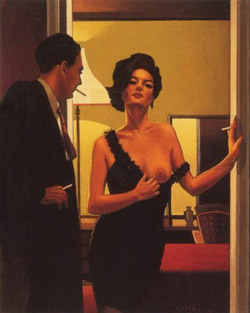
Tryin' something new: a picture! I've also just recently got my site a hit counter, and have successfully installed it myself! And I changed the layout and then played with the colors, but I'm not sure if the new color scheme took...we'll know after I post this. I have a lot more of that "practice with dialogue" to post, but I'm not sure if I'm liking it, but I'll probably post it anyway.
I really don't have much to say, I just wanted to put up this picture. I don't remember who painted it, Jack something I think, it's OK. Why is she showing her tit? And why is the guy both holding and smoking a cigarette? And, is that a mirror in the backround? Because if it is, then I'm not sure if it is doing a very good job of reflecting. Altogether not great, but I'm hoping that naked tit will attract some more attention to my site.
The last person to visit this site with whom I am not acquainted, was from Britian and searching blogger for the word "circumcision".
Friday, October 06, 2006
Some Practice with Dialogue: Exhaustion and Miscommunication (Part 1: The Meeting)
One thigh lays flat against the cold sidewalk, the foot of the other leg balances precariously on its heel, an elbow and a forearm are also pressing on the concrete, the corpulent vagrant awkwardly tries to lay himself out, to fall asleep. The late night is disturbed only by the sound he makes inadvertently scraping pebbles against the hard surface. He has been making-his-way all day long, and this lonely patch of sidewalk seemed a good place to unburden himself. Lowering himself then, on shaking limbs, his cheek has almost found the ground, his large, round behind wagging in the air, almost tasting that vanishing bliss of sleep, when a friendly voice booms from within the darkness: “Charles!”. Immediately he is on his knees, prepared for the worst, his ten fat fingers pushed into his thickly clothed chest, leaving an impression. “I’m sorry Charles, don’t have a heart attack please,” rolled on the manly voice, “don’t you remember me?”
“You stand all the way in the back of the shadows my friend, I cannot see you, let alone determine whether I know you or not,” said Charles cautiously. “I’m here all alone, I’ve found a nice spot. I’m not such a miser that I need it all for myself, so you can come on out and take a nap here too.”
“You stand all the way in the back of the shadows my friend, I cannot see you, let alone determine whether I know you or not,” said Charles cautiously. “I’m here all alone, I’ve found a nice spot. I’m not such a miser that I need it all for myself, so you can come on out and take a nap here too.”
Tuesday, October 03, 2006
Pastures
Monthly comes the farmer, his grain to sell, his friends to meet. Bales and bushels of wheat and any vegtables he might have grown. His red face full of smiles under the sun, his missing teeth a long time joke among friends. The dirt road which runs through his small town is yellow all day long, and he remembers when he was a kid, streaking the dust with his stick, no shoes no shirt. And the first time he fell in love. And the evening dances in summer, under the moon and the stars; the heavens pushing the limits of the horizion, he would sit on some rickety old chair and lose his soul amidst the stars, until his boyish cheeks were streaked with tears. And how he'd wrap himself in his mother's apron, or work all day with his father. And he'd wander. Out, out, out over the green pastures, until he found something new. And wandering again home he'd trudge along that good ol' road. Just past this self same road, out into the distance of the unclaimed land, lay tiny wild flower blossoms reaching after the sun. And nothing really ever changes these rich landscapes of meager but haunting life.
But beneath the soil dwells an angry monster, terrible to describe. His finger nails are contaminated lead pipes, cut lengthwise, and sharpened from digging in the bedrock. His skin is the color and consistency of concrete, and he wears the cap of a German academian, now long ago ruined. His legs are hairy and thick and his stomach is always empty. He would eat, but every living thing that he touches turnes slowly into cold, beautiful, marble statue, so he can never manage more than a few bites. His eyes are blue and completely normal, and he has long since stopped pitying himself. Underground, he has over the decades carved out a small gallery, which no human eyes -- save his own -- will ever see. There he displays the half eated corpses of worms and dogs -- they somehow produce their own faint light, so the viewing is rather pleasant; one may contemplate all the intricacies. In the remotest corner, a virgin, perfect in form, his eyes linger on her body, he would still kiss her if he had lips, but his toothless mouth is dry. Instead he writes bad poetry to her in the mud; and waits for the water to wash these away. Beauty, he calls her, my dear wife, he says.
But beneath the soil dwells an angry monster, terrible to describe. His finger nails are contaminated lead pipes, cut lengthwise, and sharpened from digging in the bedrock. His skin is the color and consistency of concrete, and he wears the cap of a German academian, now long ago ruined. His legs are hairy and thick and his stomach is always empty. He would eat, but every living thing that he touches turnes slowly into cold, beautiful, marble statue, so he can never manage more than a few bites. His eyes are blue and completely normal, and he has long since stopped pitying himself. Underground, he has over the decades carved out a small gallery, which no human eyes -- save his own -- will ever see. There he displays the half eated corpses of worms and dogs -- they somehow produce their own faint light, so the viewing is rather pleasant; one may contemplate all the intricacies. In the remotest corner, a virgin, perfect in form, his eyes linger on her body, he would still kiss her if he had lips, but his toothless mouth is dry. Instead he writes bad poetry to her in the mud; and waits for the water to wash these away. Beauty, he calls her, my dear wife, he says.
Sunday, October 01, 2006
Post #11
I don't think anybody new has been to my site for awhile. Still only 16 hits to my profile, I should get a general hit counter, but I don't know where, and I don't have the energy to find out tonight. I can't remember the last book I finished, I guess it was For Whom the Bell Tolls or Waiting for Godot, one of those. I'm slowly making my way through Kafka's diaries, I think they're poorly translated, but to find out and read them in German would be too much like homework. I really ought to read more often, it is stupid to play computer games instead. Now it's Fallout 2, before that Mech Commander 2, and I just brought Baldur's Gate 2 and Arcanum out of storage at my parent's place. I have a wall of books, compared to which I am only very small, and to apply what powers I have to them would be the very best thing, but instead I waste my free time, if with nothing else then with idle fantasy: I'm going to learn German, I'm going to write a thesis, I'm going to get all As, I'm going to travel; or: Civilization 4 needs more resources, and if only we could trade arms, and is it just me or do all the AI players follow basically the same track, it is almost there but it needs...etc.
What, afterall, is easier than picking up a book and reading for an hour or two?
Tommorow night is Nosferatu with the score by a live orchestra, at least that's something great. And I intend to stay on campus and do homework until it starts. If one pays attention, one finds that somedays one is more oneself, as though I were alone in my bathtub watching a large black spider on the wall, and somedays one exists not so much mechanically as like a reflection: just another person in the eyes of all those other people. Somebody, a stranger, might speak to me then, and I would just answer satisfactorily, like he would have answered too.
What, afterall, is easier than picking up a book and reading for an hour or two?
Tommorow night is Nosferatu with the score by a live orchestra, at least that's something great. And I intend to stay on campus and do homework until it starts. If one pays attention, one finds that somedays one is more oneself, as though I were alone in my bathtub watching a large black spider on the wall, and somedays one exists not so much mechanically as like a reflection: just another person in the eyes of all those other people. Somebody, a stranger, might speak to me then, and I would just answer satisfactorily, like he would have answered too.
Monday, September 25, 2006
Night Walks

The night-time shade is thick and concealing like ink. It is penetrated in front of his widened eyes by a long, angular face, corpse-white, with sparkling blue eyes and a smile. The face passes by, other faces can be seen, cracking through the dimness, their all-too-familiar pallor. he sits and he walks, he avoids the formal prescriptions of social interaction, he is comming from a party; he would like to be walking now arm in arm with a friend whom he could lean in close to and whisper something, whose eyes would be vacant, big-yellow like lemons, and watching the passers-by. Recently he held a dog brain, smaller than one might think, in his cupped hands and smelled the blood. If he could smell his own brain it would smell the same.
It is summer time, but the night is so black and the street lights so orange that he can almost see the fat, white snowflakes falling beneath them, reflecting their light all the more powerfully for the wind which blows them quickly slantwise. Thousands of golden shooting-stars comming on like a train, falling a thousand miles per hour, knocking him down with their wanton, dizzying, unrestrained momentum. He shivers. He thinks. His thoughts turn to dust. France is a really strange place, what sort of party was that anyway? I should have never gone, that is true, but why did I leave so early? Pink and white tulips as big as buffaloes with marbled streaks of white swallow up store-fronts whole. Why all the goddamn flowers? So bright one can hardly sleep.
It is summer time, but the night is so black and the street lights so orange that he can almost see the fat, white snowflakes falling beneath them, reflecting their light all the more powerfully for the wind which blows them quickly slantwise. Thousands of golden shooting-stars comming on like a train, falling a thousand miles per hour, knocking him down with their wanton, dizzying, unrestrained momentum. He shivers. He thinks. His thoughts turn to dust. France is a really strange place, what sort of party was that anyway? I should have never gone, that is true, but why did I leave so early? Pink and white tulips as big as buffaloes with marbled streaks of white swallow up store-fronts whole. Why all the goddamn flowers? So bright one can hardly sleep.
Friday, September 22, 2006
Post #11
I think the purpse of mankind is to create a game so perfect that it presents the expirence of being a human exactly.
Wednesday, September 20, 2006
Post #10
What would it mean anyway to try and speak about ourselves and the world we live in? There are plenty of words that we could use, but has anything really been said? We talk about our seperation from things, and when we hand something to somebody we do so graciously. We are nevertheless forced to speak of relationship, to analyze the pressing against of our extentions on the floor, the space we take up, and the influences of the seductions of Thing on our sped-up world view. The sickness we never feel, our desire for unreality. The swollen, felty feelers of our lying language contaminating everything they feel so delightedly and with such rapid abandon. We still speak and, more importantly, criticize. And there is much to criticize. But is relationship still one such possibility? Are we not rather something more superficial; animals perhaps all along? Our bodies press against the floor and it is nothing special, we take up space, we forget always what we look like, the thing, invested with all its corporate intentionality, remains boring. (Warhol elevated his soup can to art, and we all clapped our hands, "good job".) Our language points us towards changing horizions, we step and we end up at the border of nothingness. Argument fails because we aim to convince each other of a feeling we all feel, but cannot analyze or repair.
I think the only thing left to write is cultural catch phrases.
Is this not correct? Is it too pessimistic? Have we left something out? What the hell are we talking about anyway? Is equivocation a stylistic device? Can we continue in this vein with justification? I imagine we wrote the above note while zipping around like a heavy light-beam in a walnut shell. Are we finally just dicks if we call it a light-beam of language?
I think the only thing left to write is cultural catch phrases.
Is this not correct? Is it too pessimistic? Have we left something out? What the hell are we talking about anyway? Is equivocation a stylistic device? Can we continue in this vein with justification? I imagine we wrote the above note while zipping around like a heavy light-beam in a walnut shell. Are we finally just dicks if we call it a light-beam of language?
Friday, September 15, 2006
Addendum
Upon reflection, what I've said about mankind is not true, or it is, but only one side of the coin: death, afterall precedes birth, and forgetting paves the way for new remembrances. The philosopher must truly remain silent, but the artist might still have a chance! That new culture appears first to be merely banal might simply be its nature. Praised in its lifetime by pedants, and awed later by forlorn poets. Progress is still to much to hope for, but the end, I think, is not yet in sight; the brave may therefore still embrace action!
Post #9
Video games are perhaps a real means of cracking through reality which I like to think of as resembling an eggshell, only finely painted. That reality is really that fragile really ought not to be doubted: death gives us ample evidence to believe so. Either we become nothing, or our soul carries us somewhere else, yes? That's what Plato thought anyway, but in either case reality is shattered. Reflections of this sort lead me to hope that my present form of existence is actually a game also. That perhaps I am actually a famous historical figure of the past whose expirences I am now living, as though they were mine and with no knowledge of any disparity, with the aid of some super advanced mind-and-body-overwhelming game system.
But such is mere fantasy and really doesn't help anyway. For I must still die, no matter how many times I play the game; that is, how many different lives I am programmed to live. We could talk about the philosophical implications of such a possiblity, but in fact there are none. True philosophy, that which occurs under staircases and in broom closets, where angels live as dust and balls of twine, has already taught itself to be silent. Sadly mind you--the lesson was full of anger historically, and you would yell too if, after so many years, you discovered you were mute--but now only sadly. And the excited still do philosophy in the light, but they seem only to be adults who have decided to be children because it is easier.
The artist is the real grown-up. For the first time maybe has he the true raw power of the philosopher; he may be naked and still evil, hold out his fist with fire reflected in his eye and actually mean it in some important way. But this power is reversed, or negative: it comes not from above or behind things, but rather it belongs to the bones of the philosopher: to his words that he has sworn no longer to speak, that is, to his unspoken words. The artists' power then is no longer the power to redeem, but indeed the last vomit-green rays of human truth. A scourge demanding that mankind yield!
On the bright side, there is no mankind, and therefore no artist with the will to this power. What remains seems to be the slow forgetting: the soup of culture has run dry and we're not hungry anymore, it did taste good at the time, but with full bellies that delight is forgotten. Like the squirrel who ate bubble-gum, we'll starve to death fully satiated. And it will take so long that on our deathbed we will have forgotten that we ate anything at all.
The analogies are all breaking down now: the squirrel might now explore his world, no longer consumed with hunger. But our soup was our exploration, and yet in reality we would still explore if we could; we are therefore satiated only because we must be and we forget only because we die.
But such is mere fantasy and really doesn't help anyway. For I must still die, no matter how many times I play the game; that is, how many different lives I am programmed to live. We could talk about the philosophical implications of such a possiblity, but in fact there are none. True philosophy, that which occurs under staircases and in broom closets, where angels live as dust and balls of twine, has already taught itself to be silent. Sadly mind you--the lesson was full of anger historically, and you would yell too if, after so many years, you discovered you were mute--but now only sadly. And the excited still do philosophy in the light, but they seem only to be adults who have decided to be children because it is easier.
The artist is the real grown-up. For the first time maybe has he the true raw power of the philosopher; he may be naked and still evil, hold out his fist with fire reflected in his eye and actually mean it in some important way. But this power is reversed, or negative: it comes not from above or behind things, but rather it belongs to the bones of the philosopher: to his words that he has sworn no longer to speak, that is, to his unspoken words. The artists' power then is no longer the power to redeem, but indeed the last vomit-green rays of human truth. A scourge demanding that mankind yield!
On the bright side, there is no mankind, and therefore no artist with the will to this power. What remains seems to be the slow forgetting: the soup of culture has run dry and we're not hungry anymore, it did taste good at the time, but with full bellies that delight is forgotten. Like the squirrel who ate bubble-gum, we'll starve to death fully satiated. And it will take so long that on our deathbed we will have forgotten that we ate anything at all.
The analogies are all breaking down now: the squirrel might now explore his world, no longer consumed with hunger. But our soup was our exploration, and yet in reality we would still explore if we could; we are therefore satiated only because we must be and we forget only because we die.
Thursday, September 14, 2006
Post #8
Seven was a good number to stop at, but I changed my mind, which I'm allowed to do. Changing one's mind is the bedfellow of lying through one's teeth, therefore, if Bush changed his mind everybody wouldn't care. Anyway, I'll probably stop at 9 because that's a good number too.
So I've discovered a word that justifies anything, and that word is: literally. I'm not joking, it literally justifies everything.
I intend to eventually post and attempt to analyze a poem by Gottfried Benn that I think you all should read. I'm writing this now to remind myself to post it.
That's it. Mazur, I dedicate this post to you for convincing me to change my mind.
So I've discovered a word that justifies anything, and that word is: literally. I'm not joking, it literally justifies everything.
I intend to eventually post and attempt to analyze a poem by Gottfried Benn that I think you all should read. I'm writing this now to remind myself to post it.
That's it. Mazur, I dedicate this post to you for convincing me to change my mind.
Three Notes about God
It is about time somebody says what everybody has been thinking for awhile, namely that the Greek and Roman gods do, in fact, exist. By inference to the best explanation I tell you: they exist. Of course, it is not really correct to call them the Greek and Roman gods, they only resemble these gods. And we can't afterall know anything about them anyway, so it is pointless inventing silly cosmologies. Xenophanes told us that if horses had gods they would resemble horses. But he was wrong: horses do have gods, and they do resemble horses, which means that they mostly like to fuck and eat hay. Likewise do our gods resemble us. Also, they like to watch the Olympics and get high and shit.
One plain and not unusual day, although it was to become strange and unusual because of what happened, God's voice boomed over the sky in every spoken language and informed poor mankind thus: "My dear children, during my long sabbatical you have truly astonished my expectations; I am pleased and very displeased, and in my infinite wisdom I have decided to reward you with the curse of an elevation in status. Henceforth, you shall all be immortal. None of you shall age or bear children--those now pregnant will carry their little thinking burdens forever, and though the bodies of all children will not develope, their minds will. I grant to you, my children, an infinite depth of mind and memory, so that you will never exhaust your capacity. And I will protect each one of you from the gun and the guillotine; you shall never die. But I will not protect you from the sins of the flesh. In this way only will you not be my angels. Until the end of time you will be, and yet remain otherwise free. Praise my name."
At first nobody believed it, except the literally hundreds of thousands of people who emerged unharmed from the thousands upon thousands of car accidents all over the globe caused by God's unexpected voice.
Would the world be harder or easier to understand if it were not uncommon for children born out of wedlock to have the features of animals, or if say paintings would occasionally be animate and walk around horrified? Or if in war the dead were known to rise and slay the living? Or buildings turn and warp on their foundations, change colors violently, and then come to rest more or less normal and with a few casualties? And if solid ground would suddenly digest a pedestrian and excrete the stinking remains smelling of wet earth? We could imagine any number of things like this. But would individual man be then more easily satisfied? It is not altogether illogical to suppose so. Eating the dried cake of hope and query in vain cannot really be less satisfying than a nonsense world. The existential nightmare, pardon the cliché, is afterall the regularity and banality of existence. Rather should existence be really terrifying. War is important to mention here, because in war are things as unpredictable as described above possible. War would make more sense then, if the world itself conformed, and really, we'd all be a lot happier I think.
One plain and not unusual day, although it was to become strange and unusual because of what happened, God's voice boomed over the sky in every spoken language and informed poor mankind thus: "My dear children, during my long sabbatical you have truly astonished my expectations; I am pleased and very displeased, and in my infinite wisdom I have decided to reward you with the curse of an elevation in status. Henceforth, you shall all be immortal. None of you shall age or bear children--those now pregnant will carry their little thinking burdens forever, and though the bodies of all children will not develope, their minds will. I grant to you, my children, an infinite depth of mind and memory, so that you will never exhaust your capacity. And I will protect each one of you from the gun and the guillotine; you shall never die. But I will not protect you from the sins of the flesh. In this way only will you not be my angels. Until the end of time you will be, and yet remain otherwise free. Praise my name."
At first nobody believed it, except the literally hundreds of thousands of people who emerged unharmed from the thousands upon thousands of car accidents all over the globe caused by God's unexpected voice.
Would the world be harder or easier to understand if it were not uncommon for children born out of wedlock to have the features of animals, or if say paintings would occasionally be animate and walk around horrified? Or if in war the dead were known to rise and slay the living? Or buildings turn and warp on their foundations, change colors violently, and then come to rest more or less normal and with a few casualties? And if solid ground would suddenly digest a pedestrian and excrete the stinking remains smelling of wet earth? We could imagine any number of things like this. But would individual man be then more easily satisfied? It is not altogether illogical to suppose so. Eating the dried cake of hope and query in vain cannot really be less satisfying than a nonsense world. The existential nightmare, pardon the cliché, is afterall the regularity and banality of existence. Rather should existence be really terrifying. War is important to mention here, because in war are things as unpredictable as described above possible. War would make more sense then, if the world itself conformed, and really, we'd all be a lot happier I think.
Tuesday, September 05, 2006
My Copper Elephant
A child who grew up all alone had for company only a miniature copper elephant. Supposedly his parents had left it for him, before they disappeared. The child lived in a pleasant, if boring, place and had all the nourishment that he could desire. While most children were eating oatmeal and grits, this child feasted on sushi, barbecue, and all sorts of exoctic vegtables. He learned to read and think in many languages, and had access to a vast variety of thought provoking books. He was, however, without mother and father, and he missed them dearly like other children about whom he had read, even though he did not understand very much.
The castle he lived in had many rooms, and one had to be crafty to see them all. The child had counted: twenty, everyday, each one with something new in it. He lived in a magic castle, of this he was certain. Soft white light poured always from the hollow, reverberating walls. One had to get on one's hands and knees and crawl through small tunnels to get to the other rooms. Everyday he wanted to see the new things. Sometimes there were trap doors and they were hidden, one had to solve a riddle or puzzle before they would open. At night he feared that he had missed one; in all the days he must have missed one; what could he have missed? An object priceless without a doubt. Some news about the war? Or something French? The French soul. He loved to think about the feeling of the book in his hand when he read Sartre, he would pretend to be sick all over the little black words.
Only the copper elephant remained the same. Everday something new, and one thing the same. He always left the little thing in the main room, although he dearly wished to put it in his pocket. But he was naked, he had figured that out, naked since the day he was born, so he had no pockets, no pants either. Maybe pants will be a new thing someday. Maybe they have already, and you just didn't know how to use them. This was another of his fears; there had been many times when something simply did not make sense, and try as he might he could not fix it. None of them were pants, I would recogize pants, but one of them might lead to pants.
When he was angry or bored he would toss the little elephant hard against the noisy walls. He imagined that was what thunder sounded like. The hard elephant would scratch the tender walls. The scratches never stayed, he had heard about scratch remover, so it probably happened when you were asleep. Lots seemed to happen when you were asleep; the whole world sometimes changed.... Even the walls change, new walls. Lots of new things everyday too. I've kept books overnight before. Sometimes they come back. It all always changes. New things. Walls. But I don't know why, I ask, and I really don't know.
When I'm dead the copper elephant will still be here, it is because I am organic and therefore decay quicker. I wonder if the walls will change for him?
The castle he lived in had many rooms, and one had to be crafty to see them all. The child had counted: twenty, everyday, each one with something new in it. He lived in a magic castle, of this he was certain. Soft white light poured always from the hollow, reverberating walls. One had to get on one's hands and knees and crawl through small tunnels to get to the other rooms. Everyday he wanted to see the new things. Sometimes there were trap doors and they were hidden, one had to solve a riddle or puzzle before they would open. At night he feared that he had missed one; in all the days he must have missed one; what could he have missed? An object priceless without a doubt. Some news about the war? Or something French? The French soul. He loved to think about the feeling of the book in his hand when he read Sartre, he would pretend to be sick all over the little black words.
Only the copper elephant remained the same. Everday something new, and one thing the same. He always left the little thing in the main room, although he dearly wished to put it in his pocket. But he was naked, he had figured that out, naked since the day he was born, so he had no pockets, no pants either. Maybe pants will be a new thing someday. Maybe they have already, and you just didn't know how to use them. This was another of his fears; there had been many times when something simply did not make sense, and try as he might he could not fix it. None of them were pants, I would recogize pants, but one of them might lead to pants.
When he was angry or bored he would toss the little elephant hard against the noisy walls. He imagined that was what thunder sounded like. The hard elephant would scratch the tender walls. The scratches never stayed, he had heard about scratch remover, so it probably happened when you were asleep. Lots seemed to happen when you were asleep; the whole world sometimes changed.... Even the walls change, new walls. Lots of new things everyday too. I've kept books overnight before. Sometimes they come back. It all always changes. New things. Walls. But I don't know why, I ask, and I really don't know.
When I'm dead the copper elephant will still be here, it is because I am organic and therefore decay quicker. I wonder if the walls will change for him?
Post #7
I'm thinking I'll only from now on write prose. It is aferall the style I wish to practice. Yes, prose in general, a specific style maybe; insomuch as any style is particular to its auther. To practice a distinctive style, one with known rules, not yet, even if I make them up myself. Only a general outline at best, but something still to strive for. I'll title them also.
I'm kinda drunk, so the fist one (see above) might not be so great.
I'm kinda drunk, so the fist one (see above) might not be so great.
Tuesday, August 29, 2006
Post #6
[edited for content by author]. I believe that dream began with a football game and with me as a player. I was doing very badly, and I kept telling myself "if you stop worrying about doing badly, you'll do great", and I finally did, uplifting music began to play, and we won, or ate hotdogs or something. Later on there was also something about a construction site / hippy commune, and they refused to share. Altogether strange, but I'm happy to be remembering them, my dreams, again.
I'm smoking too many cigarettes these days. I probably wrote that to justify lighting up right now, but I'll refrain--better to wait until bed. Smoking in doors is gross and I blame non-smokers. If we all thought it was cool to do, it would be cool to do, and healthy too.... But who cares?
When Carl quit smoking he was dying of rectal malfunction, and it only aggravated his condition so that he died more quickly. But perhaps he was not displeased; it was torture to shit on subway cars and while giving speeches at weddings. The children would tease him, calling him "Shits his Pants". It follows, of course, that his father, unable to impregnate his mother, had in fact prayed one night for a son "even if he shits himself all the time". And it seems to have come true, even though Carl had not begun to shit himself until he was in his later thirties and his parents already long dead. Carl, of course, knew nothing of the curse, and so he cursed God and his misfortune. God, in return, shit uncontrollably all over Carl. For this God became quite embarrassed and defensive and so cursed Carl all over again with recal malfunction. Meanwhile, Colorado passed a law disallowing smoking inside bars and restaurants, and to get the message out a commercial was published depicting a lobster claw, moving as though animated by political will, snipping off that obnoxious lit cigarette. Carl eventually came to terms with religion, and died in a smelly puddle of his own crap.
I'm smoking too many cigarettes these days. I probably wrote that to justify lighting up right now, but I'll refrain--better to wait until bed. Smoking in doors is gross and I blame non-smokers. If we all thought it was cool to do, it would be cool to do, and healthy too.... But who cares?
When Carl quit smoking he was dying of rectal malfunction, and it only aggravated his condition so that he died more quickly. But perhaps he was not displeased; it was torture to shit on subway cars and while giving speeches at weddings. The children would tease him, calling him "Shits his Pants". It follows, of course, that his father, unable to impregnate his mother, had in fact prayed one night for a son "even if he shits himself all the time". And it seems to have come true, even though Carl had not begun to shit himself until he was in his later thirties and his parents already long dead. Carl, of course, knew nothing of the curse, and so he cursed God and his misfortune. God, in return, shit uncontrollably all over Carl. For this God became quite embarrassed and defensive and so cursed Carl all over again with recal malfunction. Meanwhile, Colorado passed a law disallowing smoking inside bars and restaurants, and to get the message out a commercial was published depicting a lobster claw, moving as though animated by political will, snipping off that obnoxious lit cigarette. Carl eventually came to terms with religion, and died in a smelly puddle of his own crap.
Subscribe to:
Posts (Atom)


